
Zakar: One Memory Shared by Every AI Tool I Use
How I built a private AI memory system that holds more than 10,000 notes, decisions, and meetings, so every AI assistant I work with starts from what I already know.
At a glance
Every AI assistant starts each conversation from zero. You explain your business, your clients, and your past decisions again and again, and each tool keeps its own partial memory that the others can’t see. I wanted one memory that I own, that every tool can read and write, and that finds the right note when I need it.
- Project
- Zakar, a personal and business AI memory system
- Problem
- Every AI tool forgot everything between conversations, and none of them shared what they knew
- Build
- One private database of memories, connected to Claude, ChatGPT, the terminal, and scheduled jobs
- Scale
- 10,698 memories, in daily use
- Availability
- The engine is open source on GitHub; my own data stays private
The situation
I run several businesses and projects at once, and I use more than one AI tool to do it. Every new conversation needed the same background: who a client is, what we decided last month, why we picked one approach over another. A decision I made while working in one assistant was invisible to the next one.
Search was its own problem. Searching by meaning handles a question like “why did we change vendors?” well, but it’s bad at finding an exact name, an invoice number, or a ticket ID. Keyword search is good at those and bad at the first kind of question.
How the AI memory system works
Zakar is one private database of memories with several doors into it. The name is the Hebrew verb in my own name, Tabari. It means “he remembers.”
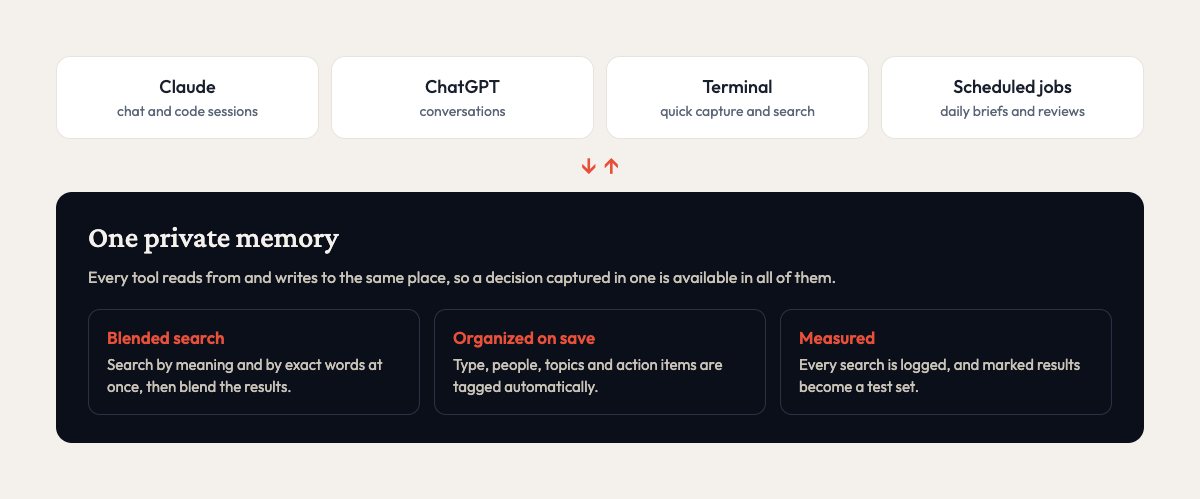
Claude, ChatGPT, my terminal, and scheduled jobs all read from and write to the same place, so a decision captured in one tool shows up in all of them.
Each search runs two ways at once, by meaning and by exact words, and blends the results. There’s an optional final pass that re-checks the top results for relevance.
When a memory is saved, the system tags its type, the people and topics involved, and any action items. I can also mark notes as decisions, insights, meetings, or ideas. During my AI work sessions, lines marked as decisions or insights get saved automatically, so I don’t have to stop and file them. Importers load past conversations and notes from ChatGPT, Claude, Obsidian, and Apple Notes, which meant it didn’t start empty.
Every search is logged. I can mark results as right or wrong, and those marks become a test set. When I change how search works, I run it against that set to see whether the change helped.
What the AI memory system changed
Zakar has been in daily use since early 2026. Today it holds 10,698 memories, including nearly 4,000 insights, about 500 recorded decisions, and about 250 meeting notes.
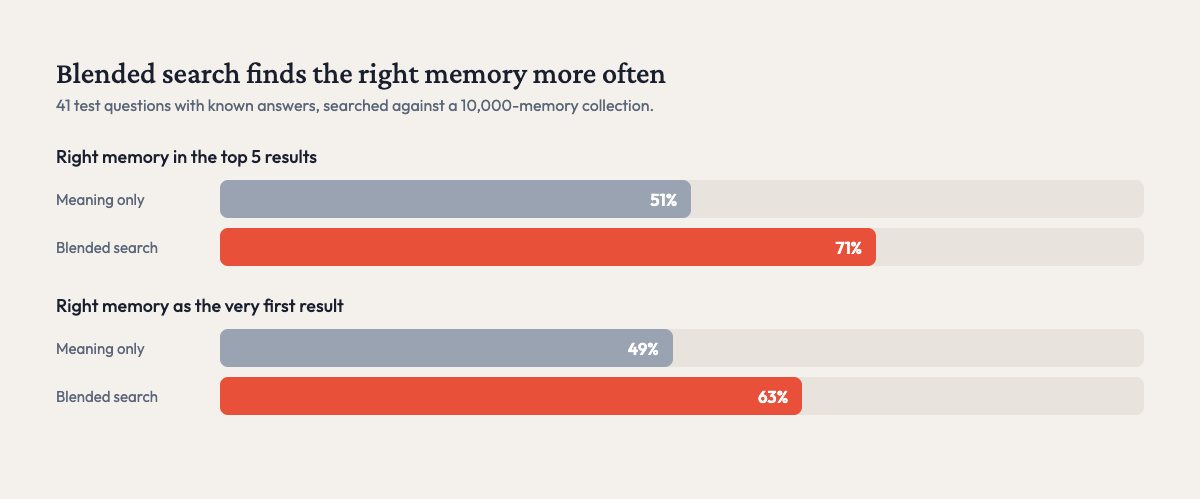
Blending the two kinds of search made a measurable difference. I ran a 41-question test against a 10,000-memory collection and compared blended search with searching by meaning alone:
| Measure | Meaning only | Blended search |
|---|---|---|
| Right memory in the top 5 results | 51% | 71% |
| Right memory as the very first result | 49% | 63% |
The engine behind it is published as open source on GitHub, so anyone can run their own. The personal parts, including my data, stay private.
Where your business knowledge should live
Keep your decisions and client context somewhere you own instead of scattered across chat histories you can’t search. If you’re building search over that knowledge, combine searching by meaning with searching for exact names and numbers, because each one misses what the other catches. And before you trust a change, test it against a short list of questions you already know the answers to.
Want your business to stop forgetting?
I build private knowledge systems for small businesses. That means one place for decisions, client history, and procedures that your team and your AI tools can all use. If your know-how lives in inboxes, chat threads, and people’s heads, let’s talk.